What to wear to an office Christmas party
Nobody tells you what "festive" means. That is the whole problem. The invitation says festive, or smart casual, or nothing at all, and you are left guessing between the two failure modes: turning up in a suit when everyone else is in knitwear, or turning up in knitwear when everyone else is in a suit.
The good news is that the office Christmas party has a fairly narrow set of correct answers, and you almost certainly own all of them already.
First, work out which party it actually is
The venue tells you more than the dress code does. A restaurant booking is a different evening from a function room with a DJ, which is a different evening again from drinks in the office kitchen at four in the afternoon.
Three quick questions settle it. Is there a sit-down meal, or is everyone standing? Is it in the building you work in, or somewhere your company has hired? And does the invitation mention a time that runs past about nine o'clock?
Standing, hired venue, running late means dress up. Seated, in the building, done by seven means dress slightly up and no further. That is most of the decision made already.
The outfit that works for nearly all of them
There is a version of this outfit that is right about eighty percent of the time, and it is not the one people reach for. It is a plain dark shirt, trousers that are not the ones you wore to work that day, and shoes with a bit of shine on them.
That is it. The reason it works is that it reads as effort without reading as costume. You have visibly changed, which is the actual social requirement, but nobody is going to ask whether you came from a wedding.
What to do with the festive part
If the invitation insists on festive, put the festivity in exactly one place and leave everything else alone. A deep green shirt. A red pocket square. Velvet on one item and nothing else. Earrings that are louder than you would wear on a Tuesday.
One loud thing on an otherwise quiet outfit looks deliberate. Three loud things looks like you lost a bet.
What the words on the invitation usually mean
Companies reach for the same five phrases, and each one is less vague than it looks once you have seen enough of them.
- Festive: dress as you would for dinner out, then add one seasonal touch. It is not an instruction to wear a costume.
- Smart casual: no suit required, but nothing you would wear to do the garden in. A shirt or knit with trousers that hold a crease, or a dress that is not for the office, and proper shoes.
- Cocktail: a step up. A dark suit without a tie, or a dress with some shine to it, and shoes you would not wear to work.
- Black tie: a dinner jacket, or a floor length or dressy midi dress. This is the one code that means exactly what it says, and turning up under it is worse than any other mistake in this article.
- No dress code given: treat it as smart casual and look at the venue. Hired room in the evening, lean up. Own office in the afternoon, lean down.
For men
The safe answer is a dark shirt in a colour that is not white, with dark trousers or good jeans and leather shoes. A blazer over it if the venue is a proper restaurant or a hired room. Skip the tie unless the invitation says cocktail or black tie; a tie at a Christmas party now reads as having come straight from a meeting.
If you want the festive thing, a deep green or burgundy shirt does it on its own. A velvet blazer does it if you own one. A novelty tie does it in the way that nobody wants.
The upgrade almost everyone can make from what they already own is the shoes. Polished leather instead of the trainers you wear to the office changes the whole outfit, and it is the one thing colleagues notice without being able to say why.
For women
A dress in a colour or a fabric you would not wear to a nine o'clock meeting is the classic answer, and it is classic because it works: velvet, satin, a metallic knit, a deep jewel colour. If you prefer trousers, wide leg trousers with a silk or satin top and a heel do the same job and are easier to sit through dinner in.
Length and neckline are where office parties differ from other parties. It is still the people you work with. Anything you would describe as a going out dress is probably a step too far for a work event, however good the venue. Sequins are fine; sequins and a thigh split at the same time are the thing people remember in January.
Shoes again. Whatever you wear on your feet will be on your feet for five hours, some of them standing, and possibly on a dance floor. Take the pair you can actually walk in, and if that means a block heel instead of a stiletto, nobody will notice and you will be glad by ten.
What not to wear
- The novelty Christmas jumper, unless the party is explicitly a jumper party. On its own day it is charming. At a restaurant dinner it is the wrong event.
- Exactly what you wore to work. See above; it is the most common mistake by a distance.
- Anything with a lanyard, a company logo or a name badge still attached. It happens more than you would think.
- Brand new shoes. Break them in at least twice beforehand, or take the pair you know.
- A single layer with no way to adjust. Function rooms swing between cold and stifling and you want to be able to take something off.
- Anything that needs constant adjusting: a strapless top, a very short skirt, a jacket that only looks right buttoned.
If the invitation has just landed
Most office parties are booked for the first two weeks of December and announced in October. That leaves time for the two things that actually take time: getting a jacket or a dress cleaned, and walking in a pair of shoes twice. Neither can be done on the afternoon of the party. Check the shoes now, check the shirt or the dress now, and the night itself becomes a ten minute decision.
It is also the moment to look at what you already own rather than what the shops are showing. The festive rail in every store is built for exactly one evening; the dark shirt, the velvet blazer and the good shoes in your wardrobe will do the party and the rest of the winter too.
Lunchtime and afternoon parties
A Christmas lunch, or drinks that start at three and are over by six, needs less than an evening party and more than a normal day. The answer is one visible upgrade to your work outfit: a better knit, a brighter shirt, better shoes, some jewellery. Enough that you look like you knew it was today. Not so much that you look like you are going on somewhere afterwards, unless you are.
The things that actually go wrong
Shoes, almost always. People plan the outfit from the top down and run out of attention by the time they get to their feet, then spend the evening in the trainers they wear to the office. If you only check one thing before you leave, check that.
Temperature is the other one. Function rooms are either freezing or unbearable and you cannot know which in advance. Layers you can take off beat a single warm thing you are then stuck in.
And if there is dancing, you will know in advance, because there is always dancing. Do not wear anything you have to keep adjusting.
Build it from what you own
Almost everything above describes clothes that are already in your wardrobe. The difficulty is not owning them. It is remembering that you own them at half past six on the night, standing in front of a full rail with your mind completely blank.
That is the specific problem Rate My Fit Now is built for. You photograph the clothes you have, the app files each garment separately, and then you type where you are going in plain words. "Office christmas party." It comes back with one piece per category, all of them yours, and a line explaining why each one was picked.
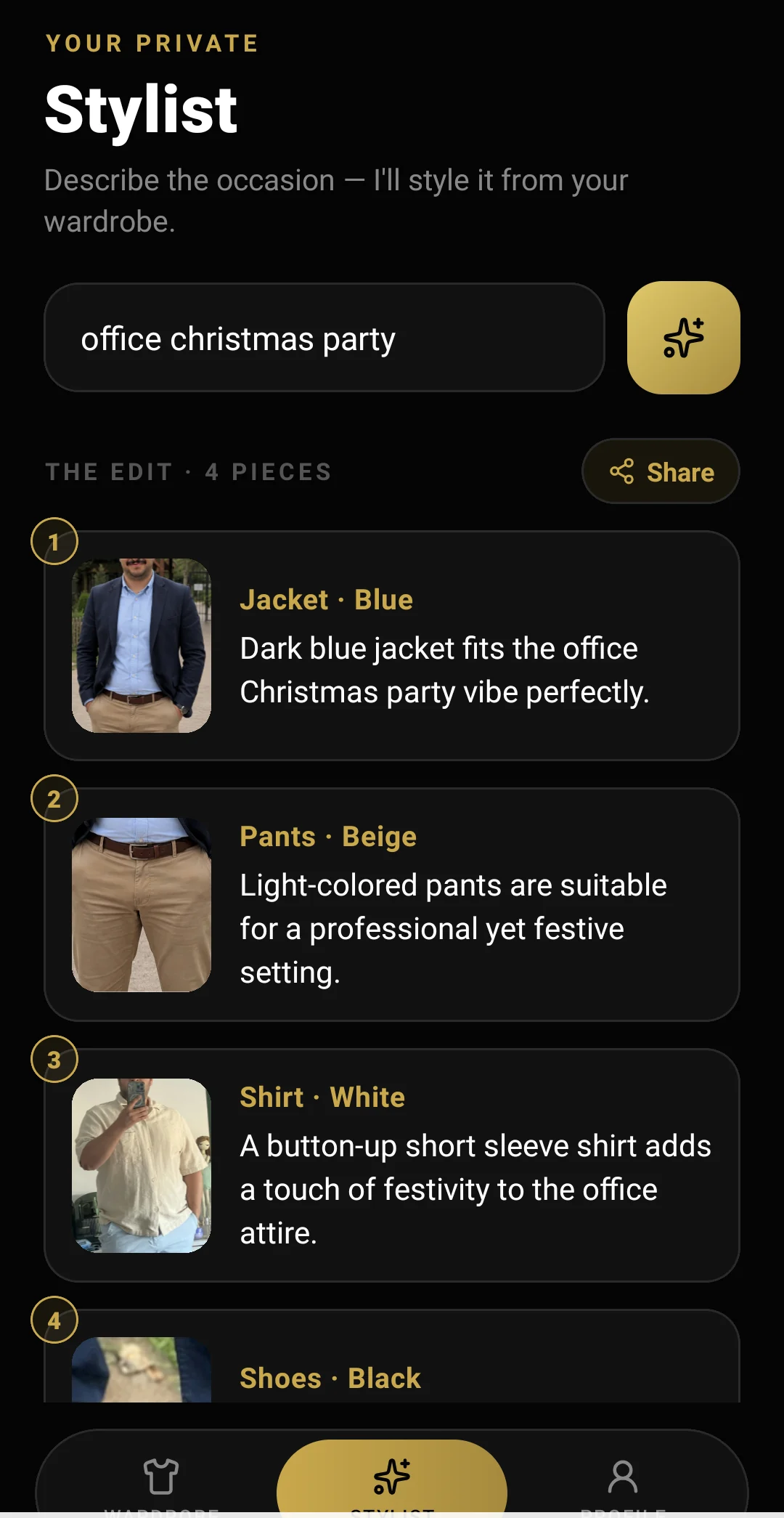
Then it films five seconds of you wearing it, from a photo you have already added, which is the part that settles the argument with yourself before you have taken anything off the hanger.
Questions people ask
Can I wear jeans to an office Christmas party?
Yes, if they are dark, fit well and the dress code is festive or smart casual rather than cocktail. Pair them with a shirt or a good knit and leather shoes, not trainers, and change out of the pair you wore to work that day.
Is a Christmas jumper acceptable?
Only when the event is a Christmas jumper day or the invitation asks for one. For a dinner or a party in a hired venue, keep the festive element to one item: a deep green or red shirt, velvet, a metallic knit, or a single piece of jewellery.
What does festive dress code mean?
Dress as you would for a nice dinner out, then add one seasonal touch. It is a colour or a fabric, not a costume. Anything you would wear to a good restaurant with one festive detail is right.
Should I change after work or go straight from the office?
Change at least one piece. Going in exactly what you wore all day is the single most common mistake, and it is visible. Swapping the shirt, the shoes or adding a jacket is enough; a full change is better if the party is in the evening at a hired venue.
What if there is no dress code on the invitation?
Treat it as smart casual and let the venue decide the rest. An evening in a hired room or restaurant means dress up a step. Drinks in your own office in the afternoon means one upgrade to your normal outfit and no more.
The short version
- Read the venue, not the dress code.
- Change at least one piece from what you wore to work.
- Put the festive thing in one place only.
- Check your shoes before you check anything else.
- Dress in layers, because the room will be the wrong temperature.
- Save the jumper for jumper day.
You already own this outfit. The hard part is finding it.